Designing with time in mind

This is the write-up of my talk at EuroIA 2013 containing my thoughts for the presentation and a set of additional resources that I found useful whilst writing my talk.

When you observe the recent rise of mobile companies such as Instagram, Twitter and SnapChat you can spot similarities in the way they approach time. They show you what happened in the last day, hour or second and they are brilliant at it. At conferences, restaurants, buses, at work or even in bed, everywhere you find people endlessly refreshing their feed, forever sucked into the eternal now.

We’re great at building tools for the now; we can design products that hypnotise people in forever refreshing. But surely we shouldn’t stop there. Digital technology can be so much more than just entertainment. What about the future? Can we build tools for the long now?

he question I want to explore is: what are the ingredients that allow us to successfully design for the organisation of time? Not just in second and nanoseconds but also years and decades. I will discuss this in three parts: first, time artefacts, such as clocks and calendars, we’ve developed to make sense of time. Second, the way our mind works with time, and finally, how we can apply this knowledge in the digital world.

Continue reading Designing with time in mind

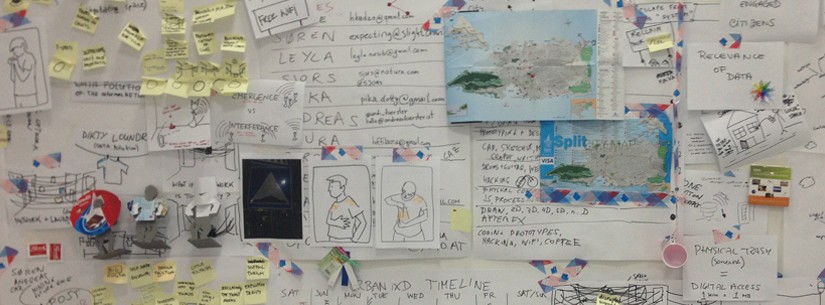
The continuous workshop of future-making: reflections on the UrbanIxD summer school

If the 19th century was about discovery and the 20th century about obtaining efficiency, then the 21st century will be about living with complexity. Complex adaptive systems are so big and interconnected that any interference with their workings causes unpredictable side effects. In these systems (such as a city) you are almost always dealing with situations that need to be addressed and rarely with problems that can be solved. For this new way of working, where every step forwards needs to be taken with caution, we need a new method, a new language and a new approach. The finding and fine-tuning of this way of working with the world was what for me the UrbanIxD summer school was about.

The challenges for cities are many: what should they expect from technology? How will the networked computer change the way we work? What are the possibilities and limits of urban change in a democratic framework? What about our environment and resources, and how can we include other people, legislations and resources in this challenge?

Continue reading The continuous workshop of future-making: reflections on the UrbanIxD summer school

8 ideas for Smart Cities

In April I attended UPLondon, an event dedicated to Smart Cities. 3 days, 20 talks and 4 debates later however, I understood less about the topic than I did before. As if the writers of The Wire had decided to turn Calvino’s Invisible Cities into a mini-series, everything connected, everyone had a hidden agenda, and every decision caused more side effects than solutions. It made it clear that cities are complicated systems, where every attempt to define a city creates a new city on the spot.

Although grand goals are easy to distinguish and to agree on, who wouldn’t want a sustainable, safe city with equal opportunities for everyone? The details of, and conflicts between, these goals is where well-lit boulevards quickly turn into dark alleys. The simple idea of a Smart City, turns out to be an endlessly interconnected situation where no one person can understand, measure, determine or plan what to do next.

One thing that contributes to Smart City’s ambiguity are the many ways people relate to data. There were people who converted data into data, turned data into plants, who gave away money for good usage of data, who used data to sync desk lamps, people who worried about the lack of privacy, or too much privacy, about traffic light sensors, about parking lot sensors, about air sensors, about equality and inequality, and the eternal question of who would pay for all this.

Overall, there were many good ideas presented. Here’s my list of 8 of them in order of appearance:

1. System thinking
“We’re more interested in looking at systems instead of sectors” said James Taplin of Forum for the Future. Splitting up problems into ever smaller parts has done wonders for creating the most complex society in history, but it has come with painful downsides that cannot be solved by even more specialisation. Thinking about a city as a collaborative/ social/ technological/ economical/ physical/ political/ cultural/ legal/ political entity might not be the easiest, but surely is the only realistic way forwards. If designers could contribute anywhere, creating insight in this complex system would be a great place to start. Hopefully we can soon see talks appearing on lean urbanism, urban pair design, strategic design, urban prototyping and balanced urban teams.

2. The poetics of digital technology
Marjan Colletti spoke about the poetics of the digital and hiding technology behind a more human face. A world less obsessed with pictures under glass, with data and efficiency and more interested in exploring the poetic side of technology and the eternal ambiguity of being alive sounds a lot more interesting than the visions that Microsoft and Nokia try to feed us.

3. Start small and reuse
Mischa Dohler spoke about using ugly cash to kickstart a smart city revolution. He gave the example of his project of implementing sensors in parking lots. The data can be used to find a parking spot, but the sensors are paid for by people who overstay or forget to pay for their parking spot. Besides using ugly cash, I’m also wondering if we can (re)use the hundreds of daily data streams that are already recorded by companies such as Tesco, Sainsbury, Addison and Lee, DHL and Royal Mail. Perhaps their data could be used by local government to do better traffic planning and infrastructure management at a cost a lot lower than placing sensors everywhere themselves.

4. Trust proxies
Several people wondered how the Internet of Things could be adopted by more people and companies. One answer to get make IoT more ubiquitous and get things like house automation, automatic heating and intelligent lights widely adopted is through trusted proxies such as the iPhone and iPad. It’s interesting to see the enormous influence that the introduction of these devices has been on the rise of Internet-enabled devices. These days there is hardly a sensor left without an iPhone app.

5. Smart cities are not about technology
That cities are for people came up many times, interestingly, to argue for opposite positions. On the one hand people argued that smart cities could be rolled out in no time if only citizens, bureaucrats and business leaders wouldn’t stand in the way. On the other hand, speakers argued that it’s not about using technology to solve problems, but about enabling people to become smart citizens. In our hastiness to see technology as the answer to unasked questions, we keep on creating problems much bigger than the ones we tried to solve.

6. Privacy
Privacy was also often discussed, almost always in the form of a question. Should cities be allowed to demand data from companies and individuals to effectively run their operations more efficiently? Should people be able to trade their data as a commodity? Should those who refuse to share be defended? If you drive the only anonymous car on the road, you’re pretty easy to spot. Should the city’s data be centralised in large databases where one small hack can reveal a whole city or should people own their own data and share it at their own choice? Should people be allowed to opt out, even when this means society as a whole is worse off? Thanks to Google glass we finally have an object that we can start using as an artefact for many of these debates, and I’m curious to see when the first court cases will show up.

7. What is tracking me?
Dr. Ian Brown wonders how we can agree or disagree to be tracked. Should devices send out special signals to notify that they are watching you? Should every wall be covered with lists of sensors listening in? Should our only means of action be to avoid these locations? Can we get data from the sensors in our periphery? Again, more questions than answers.

8. The system had a sick day
Mischa Dohler mentioned the problem with parking sensors: if the sensor spots a car who hasn’t paid, it automatically sends out an inspector. But, what if there is a very reasonable reason to park there? Perhaps the driver felt unwell and parked the car as soon as she could. Could the inspector make a human decision and pretend it was a sensor malfunctioning? Can we build space for ambiguity and exceptions in our system and refer final judgement always to a person?

The UPLondon event is a great addition to the Smart Cities and Internet of Things landscape and brought together an amazing range of speakers and ideas. I hope it will return next year and I can’t wait for the future to arrive.

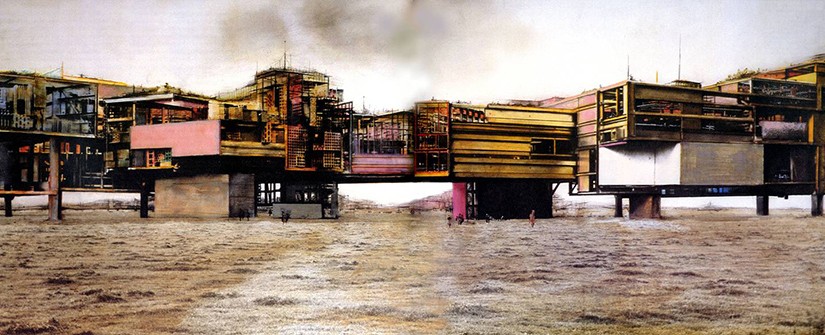
* Header image by Giovanni Battista Piranesi

Manual for a stranger world

We’ve become too practical
I’m a big fan of agile, prototyping and lean. I think a hands-on, iterative and getting-things-done process is great. But we’ve lost something. The obsession with making things real limits the scope of the things we can make real. It limits us to what is possible within the constraints of our current understanding. Companies due to their nature, are obsessed with tangible details and their delivery focused operations keep us on the path of incremental innovation. We get what we optimised for, an endless series of extrapolations: faster, lighter, bigger, cheaper. All very useful, but what about a different world? A space far beyond the horizon of the next sprint, the next launch, the next round of funding? A world of dreams, of ideas, a stranger world?

Continue reading Manual for a stranger world

Exploring eternal questions through interaction design

This is a write-up of a talk I gave at Geeky

Thanks to a side project on  time mapping I became interested in the design implications of a set of questions that are collectively known as the eternal questions.

1. What are eternal questions?
Eternal questions are concerned with meaning. They arise from people’s experiences with the world, and have no definitive answer. Famous questions are: what is the meaning of life? What is a good life? What makes a good person? What is beauty? What is love?

Although they cannot be answered definitively, this doesn’t mean that they cannot be productively discussed. Through the centuries countless people have come up with answers. Some believed they answered a question once and for all, others were more modest and saw their answer only as one of many possibilities.

Many of us are familiar with Douglas Adams’ answer from the Hitchhikers Guide to the Galaxy: “42″, the answer to life, the universe and everything. But there are many others:


Where do we come from? What are we? Where are we going?

Inspired by the simple and colourful life of Tahiti, Paul Gauguin wondered: Where did we come from? What are we? Where are we going? And came up with a surprisingly colourful answer.

In what turned out to be his final work, Dostoevsky created The Brothers Karamazov  a story about  three brothers and a father with very different ideas about what makes a good life.

Continue reading Exploring eternal questions through interaction design

Rem Koolhaas – designing the design process

Prize-winner and starchitect-in-denial, Rem Koolhaas and his studio OMA have created a method and practice that is uniquely capable of dealing with an ever more complex world. Interested in what this could mean for digital designers I started digging into their design process, in this article I’ll discuss my findings.

When asked once what his goal with his practice was, Koolhaas answered: “to keep thinking about what architecture could be. What I could be.”¹  And it is this ‘could be’ that plays a defining role in Koolhaas’ career.

0. Introduction
Rem Koolhaas studied scriptwriting and architecture and is heading OMA/AMO, an office he co-founded in 1975. You might know him from his books Delirious New York or S, M, L, XL and his practice from the CCTV HQ, Casa da Música in Porto or the Central Library in Seattle.

It is not easy to define Koolhaas. Although his buildings can be found all over the world, it’s hard to recognise a typical Koolhaas building by visual appearance alone. To define Koolhaas you have to move to his realm, leave the world of bricks and steel, and enter the world of images, models and processes, a world of ideas. Not what is, but what could be.

His buildings and his books do, however, have something that makes them recognisable as a product from OMA. A product that is very much influenced by the process of creation, a bottom up, labour-intensive, research-lead way of questioning everything. His products are assemblies, where Koolhaas refuses to give any easy answers, and instead reveals a selection of evidence and demands from spectators to form their own interpretations.

OMA Idea Machine

Koolhaas’s greatest achievement is therefore not a building or book, but a system that is capable of harvesting, questioning and producing ideas. What Koolhaas has built is a very large version of himself, a system that, through a method of researching and building, is capable of reliably creating beautiful and intelligent ideas on how the world could be. In this article I want to discuss the system that Koolhaas has built to get in that position and how he manages to remain at the forefront.

Continue reading Rem Koolhaas – designing the design process