Social networks help the villagers to rise up

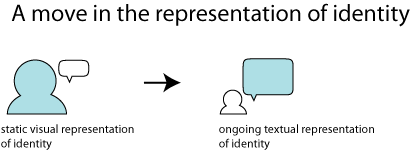
We are moving from representing ourselves online to being online. The expression of our online identity is no longer what we’ve accomplished in the past, but what we are doing in the now. Just like us, brands can no longer work on their heritage, but are challenged to actively engage in the now.

Something that has been distorted by the thick clouds of mass media, became clear once more: a brand is only a group of people working together with a common interest. In that way it comes as no surprise that brands become more like individuals. The lack of two-way communication allowed brands to act like aristocrats directing the world from within their invincible castles. These days however the villagers found ways to unite against the aristocrats, making it impossible for anyone to hide and deny responsibility behind the anonymous face of a brand. In a way it can be seen as a step backwards in time to an older model where people bought their products from local craftsmen with whom they had a personal relationship.

Top-down, directed and centralized communication is being replaced by a bricolage of presences that are dynamically generated by the multi-directional and decentralised interactions of the crowd. The brand identity is the result of this complex interaction, and it’s defined every day anew by experience. This connected and shared experience is made out of a multitude of conversations, faces, comments, quotes and images that float around the brand (but no longer controlled by it) and they define a fluid and ever changing identity.

The reason that the top-down brand strategy became obsolete so fast is that it turned out to be even less useful than pre-social media. The consumers got together faster than their rulers could divide them. More and more we will see it happening that a group of people who all have a strong personal brand come together to form supergroups. A famous example of course is CSNY, but you can see it happen in every industry. Brands should avoid being an abstract entity, and start to make clever use of the strengths of the group of people they represent. Only by putting individuals in the foreground will there be enough trust generated to truly engage.

Social media is a toolset that allows the villagers to unite themselves. The old aristocrats are still welcome among them nevertheless, but only on the condition that they leave their shield and sword at home.

An interview on UX design

A while ago I answered some questions for .Net magazine about my work at Webjam, only a few quotes got published, so it seems like a good idea to share my answers with the world.

What does user experience mean, as far as you’re concerned?
User experience is about aligning the existing elements –information, visual style and interaction- in such a way that it creates the best experience for the user whilst still adhering to the company’s goals.

Why does user experience matter? What are the benefits?
Creating a user experience is a given, creating a good user experience is hard work. A large part of human decisions are non-rational decisions, there is no checklist to conclude if we trust a site, or if a site is friendly, instead it’s a feeling felt about the whole experience. Structurally improving the experience of the users will therefore benefit business in general.
How do you approach user experience when creating websites and working with clients?

You have to be clear on two areas, first, what does the client expect that a user will do on a site? Selling their car is quite different from downloading a press release. Second, what is the type of experience they want to achieve? Trustworthy for a finance site is different from cutting-edge for a 3D designer, equally child-friendly for a Zoo is different from quality for an established tailor. Knowing the usability and experience goals will help you to determine the right approach for a fitting user experience.

How does psychology impact on UX, and are there any basic key rules designers should bear in mind when  working on projects?
In the diverse and crowded Internet marketplace the time of easy revenue for Internet companies is definitely over. A useful and usable website are conditions for entering. To get ahead of your competition you have to do more, and it is here where knowledge of psychology comes into play. From persuading a visitor to sign up to convincing a member to stay actively involved, a UX designer has to use a wide range of design elements to influence a user’s behaviour. In a way UX is borrowing more and more psychological tactics from marketing and sales.

What do people get wrong regarding UX in web design? What common mistakes do you see or misunderstandings do you find are rife?
Often there is a strong focus on just one of the elements of UX, the site looks beautiful but it is very hard to complete any task, or the site is very usable but has become so minimalistic in design that filling in your tax form seems like more fun! It is important to understand that good UX comes from understanding the customer. After that you only need to add great information architecture, great interaction, great visual design and great copy to create the winning formula.

What do you think the next big development in UX will be?
In a saturated market with highly competitive products and services, creating usable sites won’t be enough. The key question is not if the user can use your site but if they want to. Therefore, understanding and influencing user’s behaviour by using lessons learned from psychology, sociology and marketing will become increasingly important.

Social networks are changing the game

The social networks of today aren’t what they used to be. Facebook, LinkedIn and other large survivors have evolved from a simple collection of personal data (like the the files they keep about you at the CIA) to something that has no ‘old’ media comparison any more. How did we end up there, what are the social, commercial and technological changes that brought us this far and what is the effect of commercial questions on the way we can express ourselves on these social networks? These are the questions that I will try to answer in this post.

The possibility of always being online together with the large amount of the population who has broadband has turned out to be a fertile soil for social networks. In their short history they quickly rose up from static biographical pages to an oversized ticker-tape ticking away the lives of everyone you’ve ever known. Also in other areas change did roar, the move from communicating by email and forums to blogging, twittering and status updates and eventually the ‘like’ button changed the landscape again. This social-technological change combined with a change of expectations of privacy and the way we interact with technology is the backdrop for this story.

What does this mean for social networks?

First: Different people
The amount of people online has reached new heights and is slowly approaching the line where everyone who could possibly be online will have internet access. Not only are there more people, but they are also more tech-savvy, better able to deal with new challenges and less afraid to use their credit card. In short: everyone is here, they know how it works and they are not afraid to pay.

Second: A continual search for new money
Deep changes have taken place on the commercial side of social networks. Not only is there more money flowing from investors and consumers into the web, expectations have also risen to new heights, competition has brought the fee for most services down to zero, and banner blindness and internet smartness have made it harder to shake money out of visitors. I’ll highlight three money-making methods that still play a role in the design of social networks.

make_money

  • Banner advertisement (such as payment for clicks, views and sales)
  • Information harvesting (these  annoying long sign up forms you have to wrestle through, or the bright yellow boxes that tell you your profile is only 40% done)
  • Engagement enhancement (creating brand awareness, and help to find community leaders to use them to get the first two methods done more effectively)

Third: New technology and new design challenges
From a technological point the internet of today is hardly recognisable for that of 1999. “Always on” has become the default, both with the ongoing penetration of broadband, the possibilities of wi-fi and the completion of the 3G network. Computers have become faster and even do their job when sized back to phone-size. Also the software made great leaps forward, browsers became ubiquitous, ajax technology gave way to a whole new thinking about web ‘pages’, and the open-source nature of the internet allowed for high pick-up speed of innovative ideas. Social network builders have to live up to these challenges and, in the end, make a profit. They’ve figured out a couple of solutions to come to there.

  • More content in total and less content per page allows for as many banners as possible.
  • Increase the amount of places where users can leave information behind, more information is better targeted banners.
  • More engagement and activity, brings up the amount of page views, possibly the amount of clicks, and teachthe system more about its users.

Fourth: How a different design forces/allows for a different identity presentation
From how you look to what you do, where Myspace and Friendster are still based around the profile, your virtual representation in cyberspace, Facebook managed -with the help of Twitter and Friendfeed- to move beyond the profile and beyond the wall to something like the live-feed, your own micro-news CNN news-ticker. We have to understand that this is different from chatting and forum posts; these still have an internal structure, even a topic. The Facebook newsfeed is coming closer to Google Epic than Google ever came.

identity_online

  • Presentation model: based on the assumption that more pages will allow for more advertisements space, and that showing more banners would be the solution, websites catered for having as many pages as possible.
  • Interaction model: By putting more focus on creating activity, the role of social network changes too. Where in the myspace era designing a fancy style for your profile was enough, at Facebook your profile is of little matter, what counts is what you do, to exist you have to constantly feed the network, and what you feed it defines how you the world sees you.

Where marketing and experience design meet

Would you thread an ordinary notebook like this

Are those who use a Moleskin more successful, richer and more creative? Maybe a weird question. Logic tells you “of course not!”, writing in an expensive notebook should not differ from writing in one that you bought for a pound. But think with me for a moment, to be able to buy a Moleskin you need to be mentally and financially capable, so it’s quite likely that you are successful enough to allow such expenses and mentally ready to be seduced by style (or quality as they say)

Another question, are the owners of an Austin Martin more successful, richer and more powerful than those who drive to work in a Vauxhall? I bet you’d agree with me on all the three questions. Allow me to take you to another question: what came first, the Moleskin or the success? Maybe you need some success to buy your first Moleskin, but what about the second, and the third. Would you rip pages out it (like you do with that one you got for free), would you write down your shopping list, would you loose it somewhere on the way?  Or would you follow the lead that the Moleskin sets and focus more on quality and tread your ideas and behaviour with more respect?

Experience design is designing in such way that it influences behaviour, thoughts and believes.

Where have we heard those words before? In the very fine art of marketing. In the field of web-applications design we should follow the path set up by many designers before us and make products that are not only useful, (or usable) but are also a pleasure to use. From the first click on the link to your site to the very last check-box on the last tab, it’s not only the usability, the amount of features,  the personalisation options or the amount of free web-space that counts, but the quality of the experience

And it’s the quality of the experience that adds the most value to your proposition and your business. Does Coca-Cola work better against hydration than tab-water, is a Jaguar more useful to bring you from A to B than a Vauxhall, does a Suit from Savile Row keep your warmer than a trainings-suit from Primark? Of-course not, in the first world people pay a premium for a better experience. And who can blame them, for don’t you deserve the best experience?

design and emotions

In this article I want to discuss the relation between emotion and design, but first let me say why I think that we are having this discussions at this very moment (and not a decade ago (or next decade)) I see five reasons.

  • Interaction design is more than graphic design on a screen or industrial design in a browser
  • Enlightenment, modernism and the questioning  of man being rational
  • The rise of neurological research, and the continues psychological and sociological experiments
  • The availability of a massive amount of behavioural data
  • Internet companies have found themselves in a saturated market with highly competitive products

I believe this is the right moment  to connect emotions with design research. Let me first go over the word “emotional” (again) in our language emotional is often used as the opposite of rational, when you are ‘all emotional’ you are not acting rational, and even worse both also carry a value connotation, to be emotional is bad, to be rational is good. I (and many with me) think this is a strong oversimplification that will not help us any further. Emotion is in accepting that in order to make a decision we  take much more into account than only  ‘is this cheaper or will this last longer’. As Malcolm Gladwell tried to explain in his book Blink or Weinschenk in her book Neuro Web Design there is a lot of thinking going on beyond closed doors.

The estimate from neuroscientist is that our five senses are taking in 11 million pieces of information every second. And how many of those are we processing consciously? A mere 40! (Weinschenk)

Is it pure magic what happens with the other 10 million inputs? Luckily we can already say quite a lot about the way those other inputs are processed, they are (mostly) in-line with our needs (A theory on needs was developed by Maslow, the so called hierarchy of need) I don’t want to go in this too deep, but I hope you agree that there is an awful lot to take into consideration when making a decision. This taking into consideration is what I for the lack of a better therm will call ’emotional’ decision making.

Interaction design
Interaction design (or user-experience design, information design, webdesign, etc) although there isn’t makes one thing pretty clear, designing for digital interfaces is not the same as just applying old design knowledge (architecture, graphic design, industrial design) to a new medium. We need the old knowledge, but it’s not enough, we have a new thing to learn about what happens when time, humans and mediated social action meet on a screen, magic happens. To know more about this magical field many people have turned to fields originally hardly associated with design such as psychology and sociology, as I shall try to make clear in this article, it was about time.

Enlightenment and modernism
Now let’s move back a bit in history -and make some terrible generalisations- and try explain why in the first place we have to defend emotional design over rational design. In the period of enlightenment the idea man could get out of the darkness and get on the path of progress if only we would be rational came to the surface . If we would follow our mind and with the help of technology we could work towards a better future for all mankind, we could put ourselves on a infinitive track of progress. In the 20th these ideas shaped thinking about design and architecture the idea of modernism rose on the horizon. If only we would remove every non-essential part, all the clutter, all the fluff, than at the heart we would reach a perfect blend of man and technology the essence, buildings would be white and shiny, products would be simple and clean and font-faces would be simple yet beautiful. Even the short rise (and fall) of post-modern design could not stop it, post-modernism gave us a change though to question our believes, maybe there would be more in life than this.  Now with the knowledge that there is more to progress than just simply removing everything that was not necessary to the job. Emotions came back to the table.

Psychological research
A lot has happened since Sigmond Freud uncovered the subconscious, experiment after experiment prove that humans are not as rational as we think. Research keeps on proving that people are influenced by reciprocity, commitment consistency, social proof, authority, liking and scarcity (for a short introduction on these: Neuro Web Design) So although people are not rational, the factors that influence their behaviour are known and can be studied. This of-course with the hope that we will come to a rational way of understanding irrationality.

Data crunching
Now we have stated that although humans don’t behave as rational as expected, patterns in their behaviour can still be found, it is time to move on to the rise of the internet companies. Because any action that happens on a network can be registrated by that network, there is a massive amount of data available on internet usage. Data in itself is not really meaningful, just a long strings of zeros and ones. Meaning only appears after we work with this data and turn it into information. The quality of this information both depends on the kind of data, the quantity and most important the questions you try to answer with this data. If you start mixing psychological insights with quantitative data, interesting patterns start to emerge. You could for example base authority on the amounts of links that any web page gets, or you could use data clustering to create statements as ‘people who bought this also bought’. Or use it to answer if a border should be 5 or 6 pixels. Important to remember is that data is only useful when you ask the right questions.

So now we have the right mindset that by doing research we can improve the workings of technology, we have the psychological models to know where we have to look for answers and we have the data to give us the answers. Now the only thing we need is a financial stimulus to actually start working.

Web companies face a saturated. mature market
To be a successful company in the online sphere is at least as hard as to be successful in any market, there is no easy money any more. Although it might be easier than ever to start an online service and to have visitors coming your way, this is true for everyone. Thanks to the growing awareness of good usability practices most new web applications are now usable, this however is also true for the competition. To make the most out of their visitors companies have to make each visitor count. The psychological lessons about humans emotional behaviour are therefore really valuable, design that anticipates human emotional behaviour can make a visible difference in the amount of people that will actually use a website. By applying this knowledge we can move on from ‘is the user’s task doable’ to ‘does the user want to do the task’

progress

So there we have it, the mindset, the questions, the answers and the money. This is why we will hear a lot more about psychology, sociology and emotions in the design world the coming decade.

more to read:

Donald Norman’s Design and Emotion
Predictably Irrational

The amazing slide shows by Joshua Porter
Pieter Desmet research emotions method